
What a construction draw is
Construction draws are how you get money out of your construction loan to pay the people who built something this month. The bank does not hand over the whole loan at closing. It pays in pieces, after the work is in the ground, and only after someone it trusts has looked at the job and agreed the work is there. Each piece is a draw. Your builder asks to be paid, you or your owner’s rep check the request, the bank sends its inspector, the paperwork proves the subs and suppliers were paid, and the money moves. It repeats, usually monthly, until the building is done and the money the bank held back (retainage) is released.
The pay application, the lien waivers and the lender’s inspection report all measure against the same schedule of values. Understanding that one link is the most useful thing to know before the first draw.
This page covers the whole cycle; three shorter guides are its chapters: why fully funded projects still run out of cash, what the bank’s inspector looks for, and why draw schedules squeeze owner cash flow.
The Texas construction draw cycle in one picture
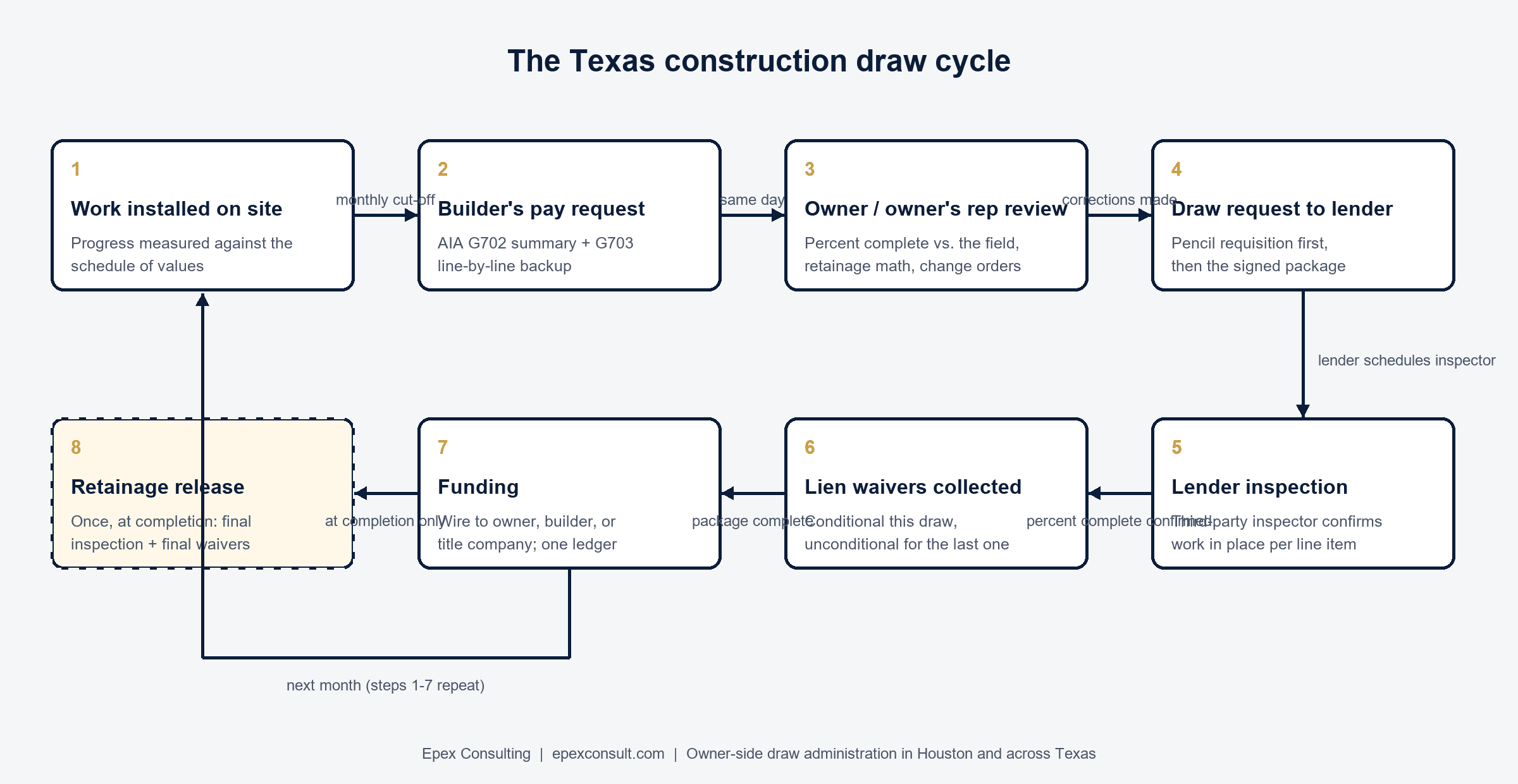
Work installed on site → Builder’s pay request (AIA G702/G703) → Owner or owner’s rep review → Draw request to lender (pencil requisition) → Lender inspection → Lien waivers collected → Funding → Retainage release. The first seven boxes repeat every month; the last one happens once, at the end.
The draw process step by step
Step 1: Work gets installed on site
Everything starts with work that is physically in place. Not ordered, not delivered, not “scheduled for Friday”: installed. The bank only pays for progress it can see, measured against the line-item budget you and the lender agreed to at closing (the schedule of values). That document splits the job into trades and phases with a dollar amount on each line. When the framer finishes the second floor, the framing line moves from, say, 40 percent to 70 percent complete, and that movement is what earns the draw. The bank funds percent complete, not spend. Material the builder has bought and deposits already paid are real cost, but not yet fundable progress. Why that gap creates cash-flow stress is its own chapter.
Step 2: Your builder asks to be paid
Around the monthly cut-off, the builder sends a formal request for payment (the pay application, usually on AIA forms G702 and G703). The G702 is the one-page summary: total contract, work completed to date, retainage held, amount previously paid, amount due now. The G703 is the backup, a line-by-line table showing each schedule-of-values item, what was billed before, what is billed this period, and any stored materials. Together they say “here is what we built this month, here is what it is worth, pay us this.” A complete request also carries the change-order log, the updated schedule, and the sub and supplier waivers from last month’s payment. New to those forms? Read G702 vs G703 before the first draw goes in.
Step 3: You or your owner’s rep check the request
Before anything goes to the bank, someone on the owner’s side has to agree with it (the owner review, or pay application review). This is the step most first-time owners skip, and the one that protects you. The review walks the G703 line by line against what is actually on site, checks that percentages are not ahead of the field, verifies the retainage math, and reconciles change orders to the loan budget. Corrections get made now, not later in a rejection from the bank. On our 8-unit Houston townhome project, that review ran lot by lot across eight loans so every dollar stayed attributable to the lot that spent it. Our draw administration service does this step every month.
Step 4: The request goes to the bank
Once the owner side agrees, the package goes to the lender as a formal ask for funds (the draw request, often sent first as a pencil requisition). A pencil requisition is a preview copy of the pay app, sent before signatures, so the lender and inspector can flag problems while they are still cheap to fix. If the inspector thinks framing is at 60 percent and the builder billed 70, that gets settled on the pencil copy and the signed request goes in clean. Not every lender uses the term, but most welcome the practice. The request itself is usually a lender form plus the pay app, waivers, stored-material invoices, and an owner’s certification, sent through a portal or, at many community banks, by email.
Follow a worked pencil-requisition review to see how a preliminary correction changes the current payment request.
Step 5: The bank’s inspector visits the site
After the request lands, the lender sends someone to look (the lender draw inspection). For most bank loans in Houston and Dallas-Fort Worth this is a third-party inspection firm hired by the bank; hard-money lenders often use in-house staff and, for smaller draws, may accept dated photos. The inspector is not there to judge quality. They answer one question: is the loan still covered by the work in place? They walk the job with the G703, estimate percent complete per line, photograph it, check stored materials against invoices, and compare this visit to the last one. The report goes to the lender, but you can ask for it. What the inspector checks and what slows them down is its own chapter.
Step 6: Proof that the subs and suppliers were paid
The bank will not release money until it sees evidence that the last payment reached the people who can put a lien on your property (lien waivers, which in Texas are the statutory forms in Property Code Chapter 53). The pattern is a chain. This month’s request carries conditional waivers, effective once payment clears, from the builder and each sub and supplier. Next month’s request carries unconditional waivers confirming last month’s payment was actually received. The lender checks the chain, not just the total. A missing waiver from a single electrician or lumber yard can hold up the whole draw, because that party still has lien rights against your land. Texas lien waiver forms explains the four statutory forms and the signing order.
Step 7: The money moves
When the inspection agrees with the request and the waivers are in hand, the lender approves and wires the money (funding, or disbursement). Depending on the loan, funds go to the owner, who pays the builder, directly to the builder, or through a title company that also collects the waivers. Whichever route your loan uses, insist on one ledger showing what was requested, what was funded, and what was paid to whom. If the funded amount is less than the request (a short draw), the difference has to come from somewhere, usually the owner’s own cash, and the reason should come from the lender in writing. Consistently short draws are the earliest warning that the budget and the field have drifted apart.
Step 8: The held-back money comes out at the end
Every draw funds less than 100 percent of the work billed. The lender, and Texas law, hold back a slice as leverage until the job is done (retainage). It sits in the loan until substantial completion, the final inspection, the certificate of occupancy where one applies, and final unconditional lien waivers from everyone who worked on the job. Then a last draw releases it (retainage release). This step happens once. It is also where many owners discover that a waiver from month three was never collected, or that the retainage on the G702 never matched what the bank actually held. Reconciling retainage every month, not at the end, is what makes the final draw a formality instead of a scramble.
How long a construction draw should take
Two norms apply in Texas, measured from a complete package reaching the lender.
Hard-money and private-lender draws
Hard-money and private lenders sell speed. The norm is funding within 24 to 48 hours after the inspection, with the inspection scheduled within days of the request. Renovation and fix-and-flip loans usually run this way. If hard-money draws take a week or more, the package is the problem, not the lender.
Bank draws
Banks and credit unions typically fund a clean draw in 5 to 10 business days from a complete package. That covers scheduling the inspector, the visit, the report, internal review, and the wire. Submitting early does not start the clock; it guarantees a rejection and a restart.
The three-week draw
Every owner’s rep in Texas has seen it: submitted on the first, missing waiver flagged on the sixth, corrected package in on the tenth, inspector visits on the fifteenth and disagrees on percent complete, money lands around the twenty-first. Meanwhile the subs go unpaid and the next draw starts late too. No single delay is dramatic; the pattern is what hurts.
What a stalled draw costs is rarely the draw itself. When funding slips, subcontractor payments slip, crews move to jobs that pay, and the schedule follows. Every extra week carries loan interest, extended general conditions and overhead, so a paperwork gap that cost nothing to prevent can eat into the developer’s margin.
Draw procedure checklist to sign with the lender before closing
Negotiated once, before closing, and rarely revisited. Put all ten in the loan documents or a signed draw procedures letter:
- Draw frequency (monthly or milestone) and the cut-off date.
- Maximum number of draws and any per-draw or inspection fee.
- Turnaround in business days from complete package to wire.
- Who the inspector is, who schedules them, and how soon after the request.
- Stored materials: fundable or not, documentation required, any cap.
- Retainage percentage, whether it applies to materials, and release conditions.
- Which lien waiver forms, from whom, every draw or only at final.
- Whether funds go to the owner, the builder, or a title company.
- A written definition of “complete package,” so nothing gets added later.
- The dispute process when inspector and builder disagree on percent complete.
Where draws go wrong
Front-loaded schedule of values. Too much value on early lines (mobilization, sitework, foundation) makes early draws fat and late draws thin; the job runs out of loan before it runs out of work. Check it against the trade bids at closing.
Stored materials billed as installed. Cabinets in a warehouse are not cabinets in a kitchen. If the G703 shows them installed, the inspector cuts the line and the draw comes in short.
Missing waivers. One sub or supplier who did not sign is enough to stop funding, and enough to file a lien later.
Inspector versus builder on percent complete. The builder says 70, the inspector says 55. Without an owner’s rep who walked the job first, the owner is a bystander to the dispute.
Funds diverted. The builder uses the draw to cover another project or an earlier overrun, and the owner finds out when a sub calls about non-payment or a lien shows up. It is the “builder is way over and I just found out” pattern behind countless owner-forum threads. Complete waivers, one ledger, and title-company or direct-to-sub disbursement are the defenses.
Texas specifics
Last reviewed October 1, 2026 against Texas Property Code Chapter 53. General information for project owners, not legal advice; for a specific dispute, talk to a Texas construction attorney.
Lien waivers under Property Code Chapter 53
Property Code Chapter 53, Subchapter L, sets out four mandatory statutory waiver forms (§53.284): conditional and unconditional waivers for progress payments, and conditional and unconditional waivers for final payment. A waiver must be substantially in the statutory form to be enforceable, so a homemade waiver from a lender or builder is a risk, not a shortcut. Both kinds come from every sub and supplier, not just the general contractor.
Retainage under Texas law
Texas owners must hold back 10 percent of the contract price, or 10 percent of the value of the work, during the job and for 30 days after the work is completed (statutory retainage, §53.101). That is separate from any retainage the lender writes into the loan: the statutory hold protects subs and suppliers, the lender’s protects the bank. Check every draw that the G702 retainage matches what the bank is holding, and do not release final retainage before the 30-day window has run and the final unconditional waivers are in.
Lender inspection practice in Houston and Dallas-Fort Worth
Bank construction loans in Houston and DFW almost always use a third-party inspection firm chosen and scheduled by the lender; the owner rarely sees the report unless they ask. Inspectors work from the G703 and the prior report and expect site access and the builder’s superintendent on hand. Hard-money lenders move faster and lean more on photos and their own staff. Either way, the inspector’s percent-complete number is what the bank funds against, so the owner-side review in Step 3 belongs before the visit.
The draw package checklist
A complete package, in the order the lender reads it: cover letter with draw number and amount; signed G702 and G703; updated schedule; change-order log reconciled to the loan budget; invoices and insurance certificates for stored materials; conditional waivers for this draw and unconditional waivers for the last one, from every sub and supplier; photos keyed to the G703 lines; and the owner’s certification. The full version, including what the inspector checks, is our construction draw inspection checklist, available to download here.
If your contractor has factored its invoices, or a title company or fund-control agent is holding the money, see lien waivers, factoring and third-party payments.
Frequently asked questions about construction draws in Texas
What is a pencil requisition?
A pencil requisition is a draft copy of the builder’s pay application, sent to the lender and inspector before it is signed. Everyone compares percent-complete numbers and catches missing paperwork while corrections are still easy, so the signed draw request goes in clean.
Can the lender pay for materials before they are installed?
Sometimes, and only if the loan documents allow it. Lenders that fund stored materials usually require them on site or in a bonded warehouse, itemized on the G703, backed by paid invoices, and insured with the lender named. Many cap the amount or exclude it, so negotiate this before closing.
Who verifies a construction draw?
Three parties, in order. The owner or owner’s representative reviews the pay application against the field. The lender’s inspector then verifies percent complete on site. The lender’s staff then review the report, waivers, and budget. Skip the first review and the inspector’s number becomes the only check on the builder’s request.
What is a lender inspection?
A lender inspection is a site visit, ordered by the bank after a draw request arrives, to confirm the work billed is in place. The inspector walks the job with the schedule of values, estimates percent complete per line, and checks stored materials. The report sets the amount funded. It is a security check for the bank, not a quality inspection.
How many draws are there on a typical build?
Most Texas construction loans are set up for monthly draws, so a nine-month build usually means nine or ten draws plus a final retainage draw. Some lenders cap the number or charge per draw, and smaller renovation loans often use four to six milestone draws.
What happens if a draw comes in short?
A short draw means the lender funded less than the builder requested, usually because the inspector cut a line item or a waiver was missing. The builder is still owed for work done, so the difference comes from the owner’s cash or waits for the next draw.
Can an owner’s representative submit draws for me?
Yes. Lenders routinely accept draw packages prepared and submitted by an owner’s representative or draw administrator, as long as the owner signs the certification the loan documents require. The rep reviews the pay application, assembles the waivers and backup, coordinates the inspection, and tracks funding against the budget.
What does draw administration cost?
It depends on project size, the number of loans, and how many draws the job will run, so we scope it per project rather than publishing a rate. The draw administration service page explains what the monthly work includes, and a project review is the fastest way to get a scoped proposal.
Get your draws reviewed before the first one goes in
Draw problems are cheapest to fix before closing and most expensive to fix at draw six. Closing on a construction loan in Houston, Dallas-Fort Worth, Austin, or San Antonio, or mid-build with draws that are not going the way this page describes? Three options:
- Construction management: we run the job day to day, including every draw, so you are never chasing the paperwork yourself.
- Independent draw administration: monthly pay application review, waiver collection, budget reconciliation, and the lender package.
- Book a 20-minute project review: bring the loan documents and schedule of values; we will tell you where the draws will bite.
This guide is general information for project owners, not legal or financial advice. Your loan agreement controls how your lender funds draws.