
FREE OWNER RESOURCE KIT
Get the Texas lien waiver forms and tracker
Enter your name and email to access all four waiver forms in PDF and Word, plus the spreadsheet tracker. The files appear after you submit. No payment required.
We use your details to respond to your resource request. Privacy Policy
Texas does not let anyone write their own lien waiver. Since January 1, 2012, a waiver or release of a mechanic’s lien or payment bond claim is unenforceable unless it substantially complies with one of four forms printed in Texas Property Code §53.284. For an owner that is good news: nothing to negotiate, only the right form to collect from the right people at the right time.
Below: the four Texas lien waiver forms as the statute prints them, which one to collect on each draw, and the Texas rules that catch owners off guard. This is general information for project owners, not legal advice; for a specific dispute, talk to a Texas construction attorney. Last reviewed October 1, 2026 against Texas Property Code §§53.281–53.284.
The four Texas lien waiver forms
Every Texas waiver covers either a progress payment or a final payment, and is either conditional or unconditional. Property Code §53.284 prints one form for each combination.
| Conditional (before the money clears) | Unconditional (after the money clears) | |
|---|---|---|
| Progress payment (a draw) | Conditional Waiver and Release on Progress Payment, §53.284(b). Collect with every pay application, from everyone billing on it. Download PDF · Download DOCX | Unconditional Waiver and Release on Progress Payment, §53.284(c). Collect after the prior draw’s checks clear. Also called an “unconditional partial lien waiver.” Download PDF · Download DOCX |
| Final payment (last check) | Conditional Waiver and Release on Final Payment, §53.284(d). Collect with the final pay application and retainage request. Download PDF · Download DOCX | Unconditional Waiver and Release on Final Payment, §53.284(e). Collect after the final check clears. Download PDF · Download DOCX |
The downloads reproduce the statutory wording without additions. Do not let anyone edit them.
The forms are the easy part. The hard part is checking that each waiver matches the draw it covers: the right amount, the right through-date, every subcontractor and supplier on the job, and last month’s unconditional waivers actually in hand before the next check goes out. If you would rather have someone check that before your lender funds, that is what our construction draw administration service does for owners in Houston and across Texas. Book a project review to talk through your next draw.
Conditional vs. unconditional, in plain English
The difference is one sentence. A conditional waiver “becomes effective” only when the signer’s check “has been properly endorsed and has been paid by the bank on which it is drawn.” Until the check clears, the sub has given up nothing; once it clears, the release is in force. That is the check-clears rule.
An unconditional waiver has no trigger. The signer states they “have been paid,” and the release is effective on signing. §53.283 prohibits requiring an unconditional waiver for a progress or final payment unless the claimant has actually received that amount “in good and sufficient funds,” and every unconditional form must carry a bold warning at the top saying so.
The statute also tells the recipient of a conditional waiver to “verify evidence of payment to the signer,” so file the cleared-check image with it. The routine: conditional waivers with the pay application, money moves, unconditional waivers after the money clears. The order is the protection.
Progress vs. final
A progress waiver covers one payment and carves out, by its own terms, “unpaid retention, pending modifications and changes, or other items furnished.” Sign one for draw 3 and only draw 3’s amount is released; retainage and pending change orders survive. Attach the G702 and G703 for the period and match the waiver amount to that payee’s G703 line.
A final waiver releases everything: the conditional final form covers “the final payment to the signer for all labor, services, equipment, or materials furnished,” and the unconditional final form states the signer “has been paid in full.” There is no retainage carve-out, so do not collect an unconditional final waiver until retainage has actually been paid.
The waiver chain on a draw
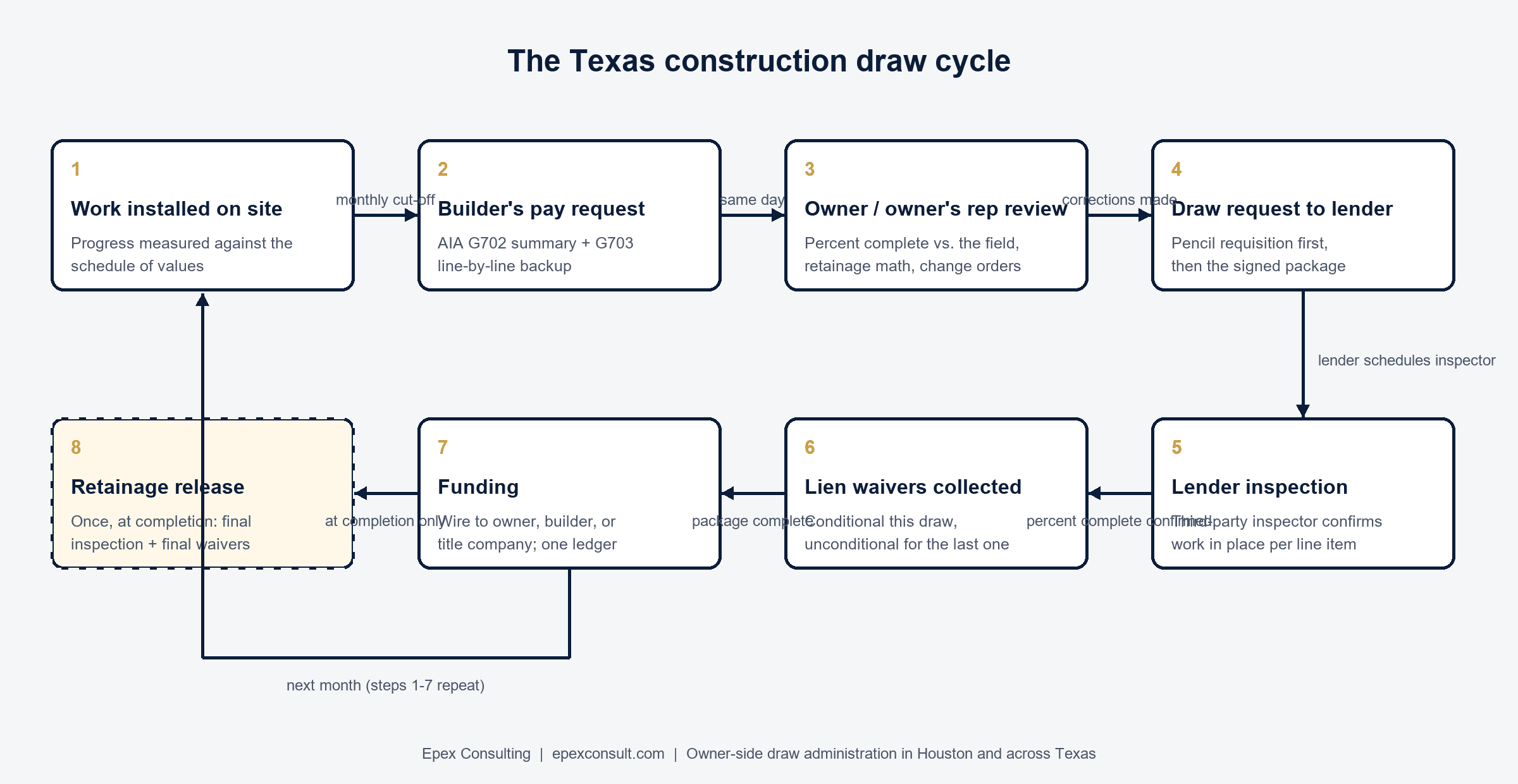
Your contract is with the general contractor, but subcontractors and suppliers who never signed anything with you can still claim against your property and the money you are holding, provided they send the notices Chapter 53 requires. The general contractor’s waiver does not release those claims; only each claimant’s own waiver does. A complete draw package therefore has waivers from:
- The general contractor (the statute’s “original contractor”).
- Every first-tier subcontractor on the schedule of values for the period.
- Every supplier that delivered material for the period.
- Second-tier subs and suppliers, such as the framer’s labor crew.
The second-tier trap: every progress form has the signer warrant that they “will use the funds received from this progress payment to promptly pay in full” their own subs and suppliers. That is a promise, not a release; if it is broken, the second-tier supplier’s lien rights are untouched and only that supplier’s own waiver cures it. Get a full sub and supplier list from the contractor at the start (§53.256 requires one on residential projects) and keep it current.
For where waivers sit in the full sequence, see how construction draws work in Texas, the construction loan draw process, the lender’s inspector, and the draw inspection checklist.
Texas rules that surprise owners
The wording is fixed by statute. Under §53.281(a) and §53.284(a), a waiver is unenforceable unless it substantially complies with the applicable form. One that adds indemnities or is copied from another state may release nothing. The rule dates from HB 1456, effective January 1, 2012.
Notarization is no longer required for most projects. Until 2022, §53.281(b)(2) required a waiver to be signed “and notarized.” HB 2237 struck those words effective January 1, 2022; a valid waiver now needs substantial compliance with the form, the claimant’s (or agent’s) signature, and, for a conditional release, evidence of payment. The catch: HB 2237 applies only to original contracts entered into on or after that date. If your owner-GC contract is older, the old rule, including notarization, still governs.
You cannot demand an unconditional waiver before paying. §53.283. A contractor who refuses to sign one for a check that has not cleared is following the law.
Contract clauses that waive lien rights are void. §53.286 voids any agreement “purporting to waive the right to file or enforce any lien or claim,” except the narrow case in §53.282(a)(3): a written contract for a single-family house, townhouse, or duplex, signed before work begins, which does not reach material-only suppliers (§53.282(c)). A “no liens” clause in a commercial contract is not a substitute.
Retainage has a clock. §53.101 requires the owner to reserve 10 percent of the contract price during the work and for 30 days after completion. A claimant who files within that window has a lien on the reserved funds (§53.103); if you failed to reserve, claimants get a lien on the property at least to that amount (§53.105). Final waivers and the release of retainage belong together.
Paying the GC does not clear the subs. A conditional waiver is triggered by the signer’s own check clearing, not by the owner paying the general contractor.
Mistakes owners make with Texas lien waiver forms
- Accepting a GC-only waiver. One signature releases one claimant.
- Reversing the order. An unconditional waiver collected before the check clears is open to challenge under §53.283.
- Amounts that do not match the G703 line. Fix it before funds move.
- Altered or non-Texas forms. A national lender template or AIA-style release does not satisfy §53.284.
- An unconditional final waiver while retainage is unpaid. The signer is asserting payment in full before it is true.
- No log. Fifty waivers across eight draws and twenty trades cannot be verified from an inbox.
Free tool: a tracker for your Texas lien waiver forms
One row per payee per draw, with columns for tier, the G703 line and amount, the waiver type expected, the amount and through-date on the waiver received, the check number and cleared date, and a status flag for mismatches or a missing unconditional from the prior draw. A summary tab shows who is still outstanding. It is the structure we use in draw administration, cut down for an owner to run alone.
Download the waiver tracker (.xlsx)
If your contractor factors its invoices
When a contractor sells its invoices to a factoring company, you may receive a notice telling you to pay the factor instead. That changes who you pay, not whose lien waivers you need. See lien waivers, factoring and third-party payments.
Frequently asked questions about Texas lien waiver forms
What is the difference between a conditional and an unconditional lien waiver in Texas?
A conditional waiver takes effect only when the signer’s check clears; until then nothing is released. An unconditional waiver takes effect when signed, because the signer states they have already been paid. §53.283 prohibits requiring an unconditional waiver before payment has actually been received.
Is a “conditional lein waiver” the same thing?
Yes. “Lein” is a common misspelling of “lien.” A search for a conditional lein waiver in Texas is looking for the Conditional Waiver and Release on Progress Payment or on Final Payment under §53.284(b) and (d). The Texas lien waiver forms above are those documents, word for word.
Do Texas lien waivers have to be notarized?
Not for original contracts entered into on or after January 1, 2022. HB 2237 removed the notarization requirement from §53.281(b)(2) effective that date; a waiver now needs only substantial compliance with the statutory form, the claimant’s or agent’s signature, and, for a conditional waiver, evidence of payment. Older owner-contractor agreements remain under the prior law, which required notarization.
Can I use my own lien waiver form or my contractor’s form?
No. §53.284(a) makes a waiver unenforceable unless it substantially complies with the applicable statutory form, and §53.281(a) says the same for any waiver under Chapter 53. A custom form may release nothing. Filling in the blanks is expected; adding or deleting paragraphs is not.
What is an unconditional partial lien waiver in Texas?
“Partial” is the industry term for a progress payment, so an unconditional partial lien waiver is the Unconditional Waiver and Release on Progress Payment in §53.284(c). It releases only the payment stated, excludes unpaid retention and pending changes, and should be collected only after that payment has cleared.
Who has to sign lien waivers on a construction draw?
Everyone who could file a lien for that period: the general contractor, each subcontractor on the pay application, each supplier who delivered material, and their lower-tier subs and suppliers. The general contractor’s waiver promises to pay the lower tiers but does not release their rights. Collecting and logging them should sit on the owner’s side, because the GC has a conflict of interest in policing its own payment chain.
Can a subcontractor still lien my property if I paid the general contractor in full?
Potentially, yes. That’s the risk the waiver chain exists to close. Paying the GC protects you from the GC, not from the plumber or the supplier the GC was supposed to pay. Texas gives owners some statutory protection, mainly properly withheld retainage, but a complete chain of waivers from every sub and major supplier, matched to what was actually paid, is the cleanest protection. General information, not legal advice; for a specific dispute, talk to a Texas construction attorney.
When should I collect the final waiver, before or after retainage is paid?
Collect the conditional final waiver with the final pay application and retainage request, and the unconditional final waiver only after the final check, including retainage, has cleared. The unconditional final form states the signer has been paid in full, which §53.283 prohibits requiring before it is true.
What does “good and sufficient funds” mean on a waiver?
It means the claimant has actually received the money, not a promise of it. §53.283 uses the phrase to define when an unconditional waiver may be required, and §53.282(a)(2) uses it to describe when a release is enforceable on payment alone. In practice, the check has cleared.
Let us collect the chain before any dollar moves
Owner-side draw administration means the pay application, the inspection, the G703 math, and every waiver in the chain are checked before funds move, and the unconditionals are chased afterward. See how it worked on an 8-unit townhome project in Houston, then book a project review or read about our draw administration service. If you would rather hand off the whole job, including every draw and waiver, see our construction management service.