
Short answer: A construction schedule of values breaks the contract sum into billable line items, and every draw you fund is measured against it. Contractors can pull cash ahead of the work in five common ways: front-loading early lines, padding mobilization and general conditions, overbilling stored materials, hiding progress in vague lump lines and over-claiming percent complete. Texas owners catch them by weighting the schedule of values before the first draw, verifying percent complete independently every month and tracking billed against built over the life of the job.
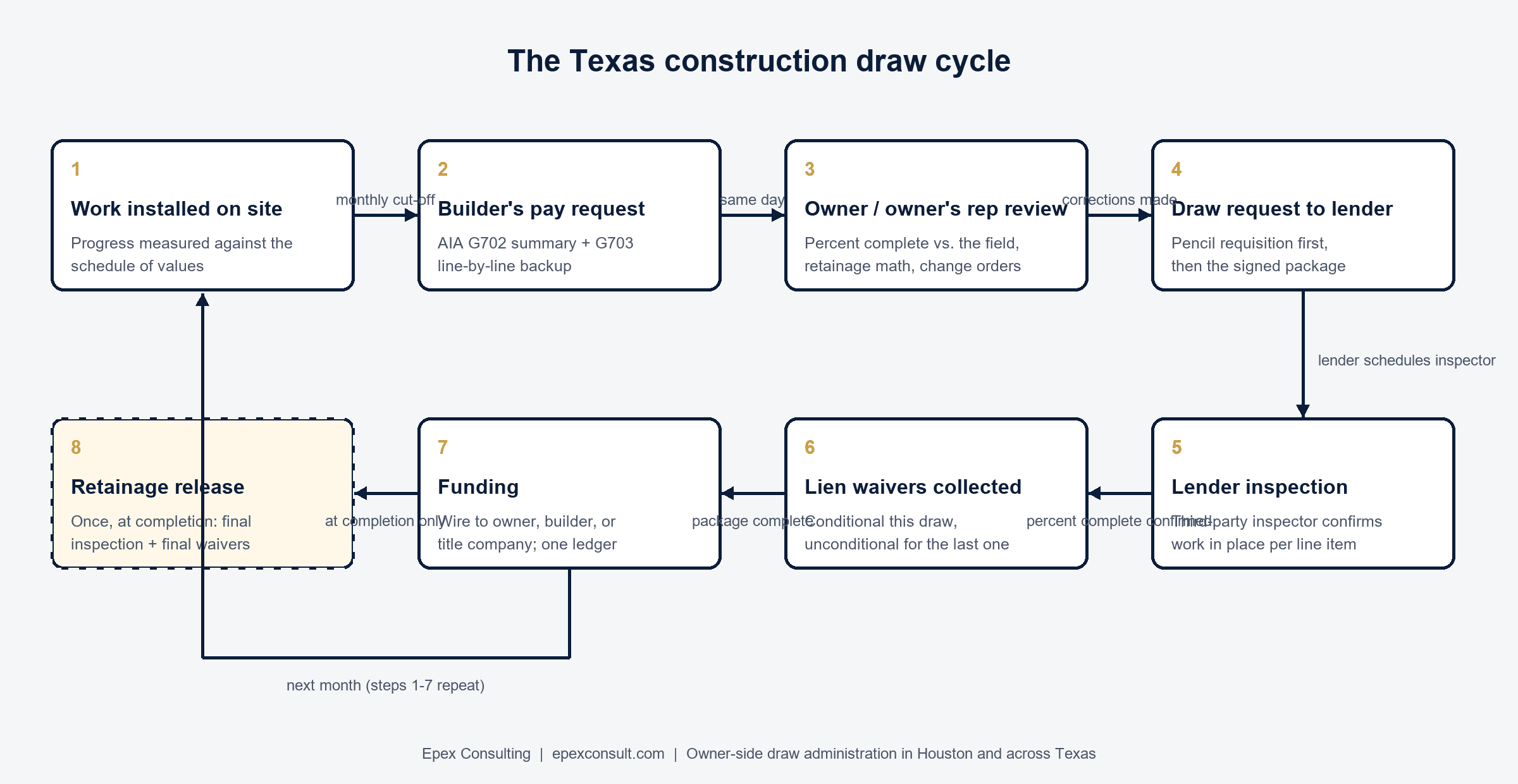
The schedule of values is the single most important document in your draw process, and the one owners understand the least. It is the itemized breakdown of the contract sum: every line of work with a dollar value, all of it adding up to the contract. Every draw you fund is measured against it. Get it right and the money tracks the work. Get it wrong and you can be 60% paid out on a building that is 45% built, which is exactly the position you never want to be in if a contractor walks off the job.
This is not about assuming your general contractor is dishonest. Most are not. But the schedule of values is where ordinary cash-flow pressure quietly shifts risk onto the owner, and a handful of common “games,” some deliberate and some just sloppy, show up on projects all the time. Here are the five worth knowing, what each one actually costs you, and the checks an owner or an owner’s representative uses to catch them before the draw is funded.
What the construction schedule of values is supposed to do
The schedule of values (SOV) takes your lump-sum contract and breaks it into line items (sitework, foundation, framing, MEP rough-in, finishes and so on), each carrying a dollar value, with the values summing to the total contract. On AIA-style billing it is the G703 continuation sheet sitting behind the G702 payment application; see G702 vs. G703 for how the two forms fit together. Each draw, the contractor claims a percent complete on each line, and that percentage drives what gets paid.
The whole job of the SOV is to make each payment verifiable. This line is 50% done, its value is $100,000, so $50,000 is earned: clean and checkable. When the SOV is honest and detailed, a draw is easy to review. When it is weighted, vague or padded, verification quietly breaks down, and that breakdown is the opening every one of the games below depends on. For the full draw cycle, see construction draws in Texas, and for hands-on help running it, draw administration.
The five schedule of values games, and how to catch each one
1. Front-loading (the unbalanced SOV)
Front-loading means loading the early line items (mobilization, general conditions, sitework, foundation) with more dollars than they are truly worth, and shorting the later items so the total still ties out. The contractor collects cash ahead of the work in place, easing their cash flow on your money.
Why it matters: it inverts the risk. Early in the job you have paid out more than the value that actually exists on site, so the remaining contract balance no longer covers the remaining work. If the contractor defaults in month four, there may not be enough money left to finish, and a completion contractor taking over someone else’s job almost never holds the original price.
How to catch it: review the SOV before the first draw, weighting each line against your estimate or the actual subcontractor contracts, and flag any early item that looks heavy. Then, every draw, track the cumulative percent billed against an independent percent complete. A persistent gap, with billing consistently running ahead of building, is front-loading in motion, even when each single month looks reasonable.
2. Padded mobilization and general conditions
Mobilization and general conditions (supervision, temporary facilities, dumpsters, fencing, cleanup) are legitimate costs, but they are a favorite parking spot for early cash because they are hard to measure against physical progress. A mobilization line sized at 8 to 10% of the contract, or general conditions billed near 100% in the first month or two, deserves questions.
How to catch it: ask for the basis. General conditions should bill roughly in step with the schedule, spread across the job’s duration, not collected up front. Cap mobilization at a defensible number and tie it to actual mobilization events rather than a round percentage.
3. Overbilling stored materials
Draws can legitimately include materials bought but not yet installed, called stored materials. The game is billing for materials that are not actually on site, are not properly stored or secured, are not insured, or get double-counted once they are installed into a different line.
How to catch it: require paid invoices, proof of on-site (or properly bonded off-site) storage, insurance, and a conditional lien waiver from the supplier before paying any stored-materials line. Then make sure the value moves out of stored materials when it moves into the installed line: billed once, not twice. Lien waiver timing matters here; see our Texas lien waiver guide and free forms.
4. Lump, vague line items
A single $280,000 “rough carpentry” line with no further breakdown is essentially unverifiable. There is no honest way to tell 40% complete from 60% complete on one giant number, and vagueness is where over-claims hide.
How to catch it: insist on a granular SOV up front. Any line big enough to matter should be broken down enough to measure. The SOV is a document you approve before work starts. That approval is your leverage moment, and it is far easier to demand detail then than to argue about it mid-draw.
5. Over-claiming percent complete
Even with a clean, balanced SOV, each draw still rides on the percent complete claimed that month. Claiming 70% on work that is genuinely 55% done pulls cash forward just as effectively as front-loading; it just does it a draw at a time.
How to catch it: do not fund on the contractor’s word. The lender’s inspector verifies progress, and a good owner’s rep walks the site against the G703 line by line, with photos and measurements, not adjectives. For what that inspection does and does not cover, see what a lender’s inspector looks for.
What an unbalanced schedule of values actually costs you
The cost of front-loading is invisible right up until something goes wrong, and then it is the entire difference. Say you are 60% funded on a $2,000,000 job that is honestly 45% built. You have released $1,200,000 for about $900,000 of work in place. If the contractor walks, roughly $800,000 of contract money remains to finish work that is worth about $1,100,000 at the original price, and a replacement contractor finishing another firm’s work rarely honors that original price. That $300,000-plus gap is the owner’s to cover, and it tends to surface at the worst possible moment.
Retainage is meant to be part of your cushion against exactly this. Texas law requires owners to hold back 10% of the contract price until 30 days after the work is complete, and a front-loaded SOV quietly eats through that cushion. Reconciling the SOV back to your full project budget is how you see the gap early rather than at handover. That reconciliation is the heart of a development budget review.
An owner’s construction schedule of values checklist
- Get the full, itemized SOV and weight it against your estimate or subcontractor values before draw #1.
- Flag the heavy early items: mobilization, general conditions, sitework, “general requirements.”
- Require line items granular enough to verify percent complete. No giant lump lines.
- Put the stored-materials rules in writing: paid invoices, on-site or bonded storage, insurance, supplier lien waivers, and no double-billing when materials get installed.
- Confirm retainage is held on every line, every draw.
- Verify percent complete independently each draw (lender’s inspector plus your own eyes or your rep’s), never on the contractor’s say-so alone.
- Track cumulative billed percent against built percent over the life of the job. Watch the trend line, not just the monthly number.
- Match lien waivers to every payment.
To set this up on your own project, start with our free schedule of values and pay application worksheet. If you would rather not learn all of this on your own job, that is precisely what draw administration and owner’s representation are for. Book a project review and we will look at your schedule of values before the first draw goes out.
Frequently asked questions
What’s the difference between a construction schedule of values and a budget?
Your development budget is the owner’s whole cost picture: land, financing, soft costs, contingency and construction. The schedule of values is only the construction contract, broken into billable line items. The SOV feeds your draws; the budget tells you whether the entire project still pencils. You want both, kept reconciled to each other, so an overbilled draw shows up against your real numbers rather than hiding inside them.
Is front-loading illegal?
Usually not. It is a billing tactic, and a modest amount of early weighting can even be legitimate, because real mobilization costs are real. It becomes a genuine problem when it is material and undisclosed, because it shifts default risk onto the owner without anyone deciding that on purpose. The fix is contractual and procedural (an approved, balanced schedule of values and independent verification each draw), not an accusation aimed at your contractor.
Isn’t my lender supposed to catch this?
The lender’s inspector protects the lender’s collateral and confirms that work is progressing, which does help you. But their job is not to protect your equity or to scrutinize how the schedule of values is weighted line by line. That gap, between “the bank is satisfied” and “the owner is protected,” is exactly what an owner’s representative or draw administrator is there to fill.
We’re first-time owners and the schedule of values looks fine to us. Should we worry?
“Looks fine” is the whole trap: a front-loaded SOV looks completely normal unless you weight the lines against real costs, which most owners have no reference for. If this is your first ground-up project on a construction loan, having someone review the schedule of values before the first draw is among the cheapest insurance you will ever buy on the job. Our first-time owner’s guide walks through what to look for.
3 Responses