
Short answer: A first-time townhome construction budget usually has the builder’s number right and everything around it wrong. The line items that get left out are rarely framing or roofing. They are utility taps and impact fees, fire-rated walls between units, drainage and detention, shared site costs that nobody agreed how to split, permits and platting, financing and draw costs, carrying costs while you wait, and the selling costs at the end. Build the budget in five parts (land, hard costs, soft costs, financing and carry, contingency), make every hard-cost line match the schedule of values your lender will fund against, and decide up front how shared costs are allocated between units.
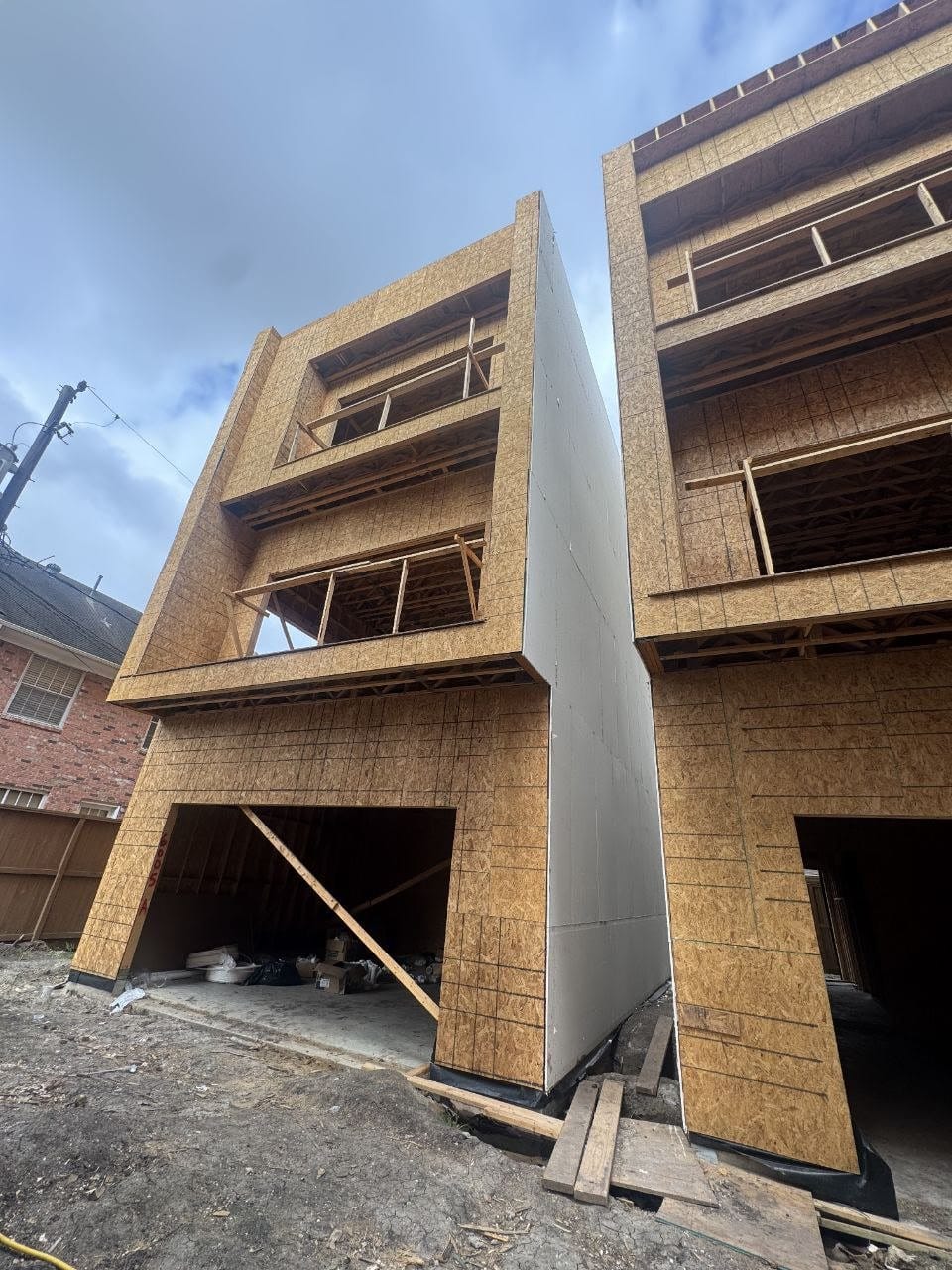
Most first-time townhome developers start with a builder’s price per square foot, multiply it out, add the land, and call that the budget. The builder’s number may be perfectly fair. The problem is what sits outside it. On a small infill townhome project in Houston, the costs the builder never priced can decide whether the deal makes money, and they tend to show up as surprises in the middle of construction, when cash is tightest.
This guide walks through a townhome construction budget the way an owner’s representative builds one: the five parts, the hard-cost lines your lender will expect, and the items first-timers most often leave out. The examples come from the kind of work we do on Houston townhome projects, including an eight-unit townhome development where we managed construction and ran the draws for eight separate owners.
A townhome construction budget has five parts, not one
- Land and acquisition: purchase price, closing costs, title, survey, due diligence and any demolition of what is on the lot.
- Hard costs: everything the builder and trades put in the ground and on the building, organized the way your lender will fund it.
- Soft costs: design, engineering, permits, fees, insurance, legal and everything else that is not labor or material on site.
- Financing and carry: loan fees, interest, draw costs, property taxes and insurance while the project is under construction and until it sells or stabilizes.
- Contingency: money set aside for what will go wrong, held separately so it is not quietly spent on upgrades.
The builder’s bid covers most of part two and little of the rest. A budget that is only the builder’s bid is not a budget.
The hard-cost lines your lender will expect
Your construction lender funds draws against a schedule of values, so the hard-cost side of your budget should use the same lines. On the eight-unit project, every unit carried the same 37-line schedule of values, which made it possible to compare units, catch overbilling and keep each owner’s money separate. A typical townhome breakdown runs roughly in the order the building goes up:
- Site preparation, demolition and clearing, temporary utilities and erosion control
- Foundation (designed by the engineer for the soil report; expansive clay is common in Houston)
- Framing, sheathing and structural hardware
- Roofing, roof decks and waterproofing
- Windows, exterior doors and garage doors
- Plumbing, electrical and HVAC rough-in
- Insulation and fire-rated assemblies
- Drywall, including the rated walls between units
- Exterior cladding, cornice and trim
- Paint, interior trim and doors
- Cabinets, countertops, tile and flooring
- Plumbing and electrical fixtures, HVAC equipment and appliances
- Driveways, flatwork, final grading, fencing and landscaping
- Final cleaning and punch list
The level of detail matters more than the exact names. A line big enough to matter should be small enough to verify. That is how you catch a front-loaded schedule of values before it costs you.
The line items first-time townhome budgets leave out
1. Utility taps, meters and impact fees
Connecting new townhomes to City of Houston water and sewer requires a wastewater capacity reservation, tap and meter work and, in most cases, impact fees charged per service unit. These are usually outside the builder’s price. Meter location can add its own surprise: on one Houston townhome project, a water meter had to be set across the street, an extra cost no one had budgeted. Ask early where service will come from and who pays to bring it to each unit. Our Houston permit timeline guide covers the capacity letter and when to apply.
2. Fire-rated walls between units
Attached townhomes need fire-rated separation between units under the residential code, and those assemblies cost more than an ordinary interior wall in both material and labor. They also need to be built and inspected in the right sequence. Make sure the builder’s price, and your schedule of values, carry them as a visible line.
3. Drainage, detention and grading
Infill townhome sites in Houston often need drainage work, and depending on the site and its jurisdiction, detention. Final grading has to move water away from slabs on a lot with very little room. These costs belong to the site, and first-time budgets often assume they are inside the builder’s price when they are not.
4. Shared site costs and how they are split
On a multi-unit project, many costs serve every unit at once: dumpsters, portable toilets, temporary power, fencing, a shared drive, utility tie-ins, a container offload, a surveyor’s visit. If the units have different owners or separate loans, someone has to decide how each shared cost is divided, and that decision should be in writing before the first invoice arrives. On the eight-unit project we kept a cost-share statement for shared site services so every owner could see exactly what their unit was charged and why. Without a rule, one owner ends up subsidizing another and the draw records stop reconciling.
5. Platting, permits and plan review
Many Houston townhome sites start as one lot that must be replatted into several. Platting, plan review, permit fees and the time they take all belong in the budget. Time matters as much as fees, because every month waiting for approvals is a month of interest and taxes. See the Houston permit timeline for the sequence.
6. The builder’s fee and general conditions
Know exactly what the builder’s fee covers, how it is paid and what is billed separately. On cost-plus and fee-based arrangements, the fee is often paid in installments tied to milestones, and supervision, cleanup, equipment and temporary facilities may be billed as general conditions on top. Read it as a line, not a percentage.
7. Allowances, selections and extras
Allowances for cabinets, tile, fixtures, appliances and lighting are where budgets quietly grow. Price your actual selections against each allowance before you sign. Then expect small field extras: on a typical project, plumbing rough-in alone can generate extra charges per unit when layouts change or conditions differ. A budget that has no line for extras will absorb them out of contingency, or out of your profit.
8. Soft costs
- Architecture, structural and civil engineering, MEP design
- Geotechnical report and survey (including form board and final surveys)
- Permit, plan review and inspection fees
- Builder’s risk and liability insurance
- Legal, entity formation and, if units will be sold individually, the documents that set up shared areas or an owners’ association
- Accounting and draw administration
9. Financing, draws and carry
Construction loans carry origination fees, interest on the balance as it is drawn and often an interest reserve. Each draw can carry its own costs, such as a lender inspection and a title update. Property taxes and insurance keep running until the units sell or are refinanced. Model the interest month by month against your draw schedule, not as a single percentage.
10. Selling or lease-up costs
If you plan to sell the townhomes, budget for commissions, seller closing costs, staging and the months they may sit on the market. If you plan to rent, budget for lease-up time and make-ready. These are part of the deal even though they happen after the certificate of occupancy.
11. Contingency
Set a contingency on hard costs and a separate one on soft costs, and decide in advance who can spend it and for what. Many construction lenders require a hard-cost contingency and will tell you the minimum in the term sheet. Treat it as a reserve for real problems, not an upgrade fund.
What we learned running an eight-unit townhome budget
The eight-unit townhome project had eight owner LLCs, eight construction loans and one shared jobsite. Three practices kept the budget honest:
- One template, every unit: the same 37-line schedule of values for each unit, so unit-to-unit differences stood out immediately.
- A written rule for shared costs: shared site services were split by statement, not by guesswork, and every owner could see their share.
- Every dollar attributed: each payment matched to a unit, a cost line and a source of funds before it aged, so the budget, the ledger and the draws always agreed.
None of that is complicated. It just has to be set up before the money starts moving.
A first-time townhome budget checklist
- Split the budget into land, hard costs, soft costs, financing and carry, and contingency.
- Match hard-cost lines to the schedule of values your lender will fund against.
- Confirm in writing what the builder’s price excludes, especially utilities, impact fees, drainage, fencing and landscaping.
- Price your real selections against every allowance.
- Put the fire-rated separation walls on their own line.
- Write down how shared site costs will be divided between units.
- Model interest, draw costs, taxes and insurance month by month through sale or refinance.
- Include selling or lease-up costs.
- Hold separate hard-cost and soft-cost contingencies with clear rules for spending them.
A development budget review tests all of this before you close on the land or sign with a builder, and draw administration keeps it honest once construction starts. If this is your first townhome project, start with our first-time owner’s guide or book a project review.
Frequently asked questions
What should a townhome construction budget include?
Five parts: land and acquisition, hard costs organized like your lender’s schedule of values, soft costs, financing and carrying costs, and contingency. The builder’s bid covers most of the hard costs and little else.
What costs are usually not in the builder’s price?
It depends on the contract, but commonly utility taps, meters and impact fees, permit and platting costs, design and engineering, drainage or detention beyond the building pad, fencing, landscaping, financing costs and selling costs. Get the exclusions in writing.
Do I need a separate budget for each townhome unit?
If the units have different owners, separate loans or will be sold individually, yes. Give each unit its own schedule of values and its own draw record, and keep a written rule for splitting shared site costs.
How much contingency should a first-time townhome developer carry?
Your lender’s term sheet will usually set a minimum hard-cost contingency. First-time developers are often better off carrying more than the minimum, plus a separate soft-cost contingency, because their estimates have not yet been tested by a completed project.